Showing posts with label google+. Show all posts

Thursday, June 30, 2011

Official: Google Analytics Gets Social Engagement Reporting

Google Analytics has just announced a new set of reports (and functionality) that will enable websites to track social interaction with their content. This comes as a welcomed addition to the new Google+1 button, as it now enables one to measure the impact of social interactions in and outside websites (either through a Facebook like, +1 or LinkedIn share inside the website or +1 on search results).

The new reports can be found in the Visitor section (make sure you are using the new Google Analytics) and are seeing the following:

  • The Social Engagement report shows site behavior changes for visits that include clicks on any social sharing actions. +1 is added automatically, but other sharing buttons should be added through coding, see below how to define them. This allows website owners to understand whether there is a different behavior between visitors that share and visitors that do not share or between different types of “sharers”.

  • Social Engagement Report

  • The Social Actions report shows the number of social actions (+1 clicks, Tweets, etc) taken on the site. This can be helpful to prioritize which share buttons should be in the header of an article, for example:

  • Social Action Report

The Social Pages report shows the pages on the site driving the highest the number of social actions. This is very useful to learn which content is viral and what your visitors really like to read to the point of sharing it with their friends.

Social Entity Report

This change is so meaningful that Google went the extra mile to create the Social Interaction Tracking, a new tracking function that will be used for social tracking only. Basically, the syntax is as follows:

    _trackSocial(network, socialAction, opt_target, opt_pagePath)
  1. Network: Name of the social network (google, facebook, twitter, digg, etc)
  2. SocialAction: Type of action (like, tweet, send, stumble)
  3. opt_target: Subject of the action being taken. Optional, defaults to the URL being shared (document.location.href). Can be manually set to anything: a different URL (if they’re sharing content that “points” to another URL), an entity (e.g, product name, article name), or content ID
  4. opt_pagePath: The page on which the action occurred. Optional, defaults to the URI where the sharing took place (document.location.pathname). Can be manually set (like a virtual pagename).
For a more technical overview on how to implement this tag for facebook and Twitter visit the code site article.

As concluded on the Google Analytics launch post (link above):
Social reporting is just getting started. As people continue to find new ways to interact across the Web, we look forward to new reports that help business owners understand the value that social actions are providing to their business. So +1 to data!

Monday, June 6, 2011

Chinese Warn Google May Get Punished For Making Country Look Bad

 
China is being very defensive. Google’s recent 
exposure of more attempted Gmail hacking, targeting US government officials and Chinese human-rights activists, has made the Chinese government embarrassed and angry.


Suspected state-sponsored Gmail hacking is what initially caused Google to discontinue cooperating with China’s internet censorship policies.

Chinese: Google Is a “Political Tool”

Last week’s hacking incident and Google’s statements that indirectly point to the government as the source have the Chinese seeing red, so to speak. Claiming that China is being unfairly maligned, the Chinese are warning (though official publications of the Communist Party) that they may seek to punish or retaliate against Google in some way.
The Chinese government has consistently and angrily denied any involvement in Gmail hacking incidents. And it has never been entirely proven that the government was directly or indirectly involved. However Wikileaks documents (together with third party security analysis) strongly implicate (if not confirm) the hacking was carried out by the Chinese government or its surrogates.

Experts: Hacking Part of a Sustained Espionage Campaign

China says that Google’s implied accusations are “deliberately pandering to negative Western perceptions of China” and that Google has become a “political tool.” However Chinese Gmail hacking is reportedly part of a long-standing campaign by “cyberspies” in China to gain access to US defense and corporate information.
According to the Wall Street Journal:
James Mulvenon, a China and cyber-security expert, has been tracking a four-year phishing campaign against China specialists in Washington. He’s logged more than 100 rounds of attacks against 30-40 China specialists, many of whom have rotated in and out of government . . . The goal of this campaign in Washington appears to be to gather information from individuals who communicate with U.S. officials about China matters, Mr. Mulvenon said.If cyberspies gather sensitive but unclassified data from Washington research institutions and a smattering of U.S. officials, he said, “you get a pretty good picture of what’s going on in Washington as it relates to China.”

A New Cold War

Welcome to the new Cold War. Going forward it appears that the US and China will seek to maintain cordial relations publicly — China is the largest US debt holder and the US is a critical market for Chinese goods — while conducting computer-based espionage and counter-espionage operations against each other behind the scenes.

Thursday, June 2, 2011

Google Drops Numerous APIs, Including Translate

If one year ago I had come in with an announcement that “Google dropped X product,” it would mean that Google had seriously messed up, miscalculated, or determined that a service couldn’t survive in the market. Google dropping a project no longer means the same thing, however. Since the April management shuffle (which occurred immediately after Larry Page re-took the reigns of Google), Google has been relentlessly dropping projects – including ones that are viable. This trend continues this month with Google dropping 11 developer APIs, including the popular Google Translate API.

To clarify, that doesn’t mean Google is dropping these services in their own outlets (such as the Google Translate website). Translate, as well as the other services related to the soon-to-be abandoned APIs, will continue as normal in the Google web and mobile apps. But developers who want to integrate the Google services, such as Translate, into their own web or mobile app rely on these developer APIs; the API is the medium by which developers access the Google data.


“Deprecating the Translate API was the hardest choice for us to make,” said Google representative Adam Feldman. But in the end it was a simple matter of how the popular API was being used. “The Translate API was subject to extensive abuse – the vast majority of usage was in clear violation of our terms.” He did not specify exactly what terms of service violations were taking place.

Developers who were using the API will continue to have access to the Translate data until December 1st of this year. Prior to that date developers will be limited on the number of inquiries made per day. The ten additional APIs being shut down are the Blog Search, Books Data, Books JavaScript, Image Search, News Search, Patent Search, Safe Browsing, Transliterate, Video Search, and Virtual Keyboard. Additionally, the Code Search, Diacritize, Feedburner, Finance, Power Meter, Sidewiki, and Wave APIs have ceased active development but there is no plan to shut down the APIs themselves.

Wednesday, June 1, 2011

Official: Google +1 Button For Websites Comes Tomorrow


It’s official. Google’s +1 button for websites will be coming tomorrow. A launch partner accidentally tipped the news of the release to TechCrunch, and Google’s since confirmed with me that it will be happening.


Google tells me that any site will be able to to add the +1 button code to their site as of tomorrow, through a self-serve process. The company says a full blog post and more details will be posted tomorrow.

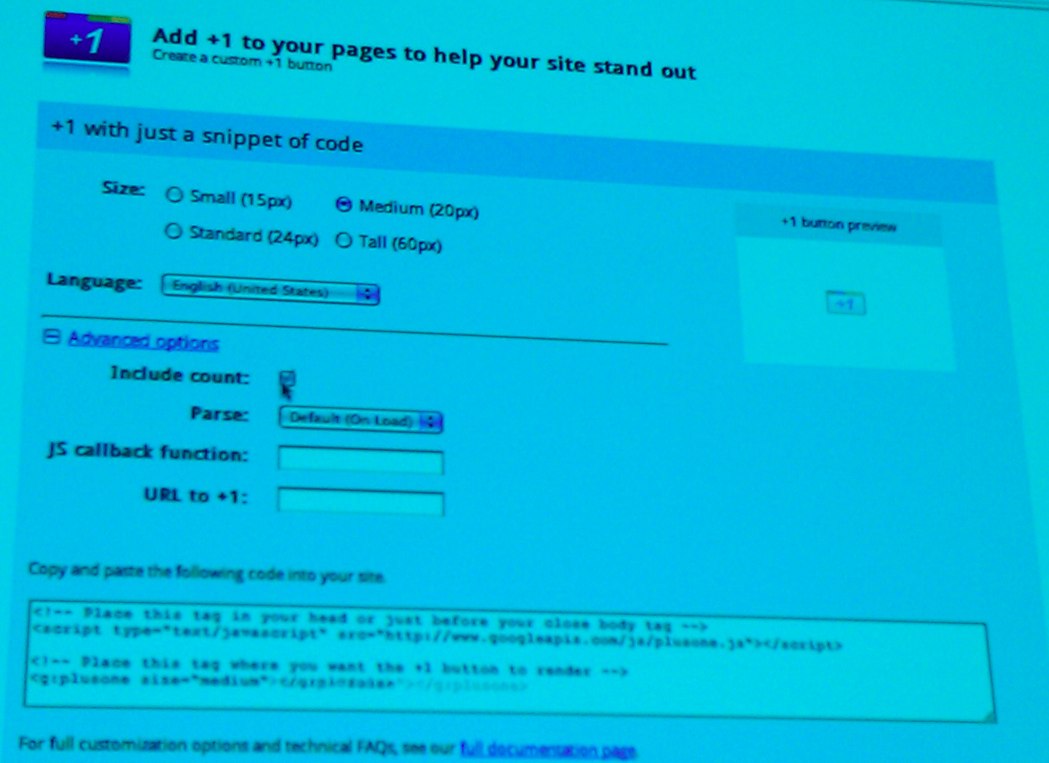
My previous post from earlier this month, Just Weeks Away, A Preview Of The Google +1 Button For Websites, gives a pretty good idea of what to expect in terms of implementing the button. You can expect a self-serve form like this:


If you’re registered with Google Webmaster Central, you’ll have access to button-push analytics, similar to this:


It remains unclear if the buttons will in turn link to any broader social sharing on Google itself. Right now, the only way those within your social network on Google will see what you’ve +1′d is if you have effectively created a fresh network just for this, deliberately chosen to expose your +1 activity, and if you’re friends know exactly where to look to see this.

That’s a far cry from the ease that people can share what they like on Facebook with friends, to me a key factor in the success of the Facebook Like button. My previous post, Has Facebook Become The Master Key To Unlocking The Web?, goes into more depth about this and the challenge Google faces competing with that system.

In somewhat related news, Twitter has just released a “Follow” button for web sites, which allows people to easily follow a site rather that just tweeting articles from it.

Google’s Re-Focus, Its Meaning, and Its Risks

When it was announced in the early portions of 2011 that Eric Schmidt, long-time CEO and established C-level guru, was handing the control of Google back to original founder Larry Page, we knew that big changes were ahead. It was hard to say, however, whether Page’s leadership would mean more of the same or if Google may turn over a new leaf, for better or worse. Now it’s clear that Page is breaking from many of Schmidt’s examples; while Schmidt was the “adult supervision” and active mentor for Page, and continues to fill an advisory role, Page’s path has taken on a very different focus.

More specifically, Page is narrowing the efforts of the company. This began with the April management shuffle, wherein several VP positions were eliminated, several were created, and almost all the “key player” roles in the company changed. Several unexpected twists also took place, with Jonathan Rosenburg leaving the scene entirely (being unable to commit to a long-term role at Google) and Marissa Mayer being dropped from the leadership of the company; could it be her comments on Google’s failure at social upset someone?

But a management shuffle was only the beginning. Google has also dropped a number of projects, either halting development for, shutting down, or merging numerous key projects. This includes the Newspaper Archives project, the Android OS 3.x line for tablets, Google Hotpot, and many developer APIs (18 in total as of the May announcement). But what does this cleanse really mean?


For one, it means that Google is pooling its resources for more critical projects. Want a hot tip? The critical project in question is almost certainly social. Googlers have their bonuses tied to Google’s success in that arena, Google recently released two major social search elements (+1 and promoted results), and Google Circles (the rumored name of the social network) may still be on the horizon.

But what is Google sacrificing to narrow their efforts? Sure, the company is dropping a lot of dead weight, but they’re also dropping several profitable projects. As Google continues in its minimalist cleansing, it’s possible that they’ll lose some flexibility in innovation, one of the strengths that previously defined the company, and may upset developers in the process. Considering the importance of web and mobile app developers to core Google projects (especially Android, Chrome, and Chrome OS), Google must proceed with caution.

Source: http://www.searchenginejournal.com/googles-re-focus-its-meaning-and-its-risks/30205/

Thursday, March 24, 2011

Google's Cat & Mouse SEO Game

This infographic highlights how Google's cat and mouse approach to SEO has evolved over the past decade.

One of the best ways to understand where Google is headed is to look at where they have been and how they have changed.

Click on it for ginormous version.

Google's Collateral Damage.
Infographic by SEO Book