Thursday, May 12, 2011

Keep Your Website Content Unique: Battle The Pirates That Are Stealing Your Content

You’ve worked hard to create some great content for your site. You’ve done all the right things. You’ve written original articles that are great for users and are optimized for excellent search engine placement.

Everything seems fine until you start to do some searches to see exactly how well your content is performing. You look for a few of your articles and find websites from here to the Ukraine that are posting your articles.

Pirate Content


Why keeping your content unique to your website is important

This is a problem. The value of your content is instantly diluted or maybe even totally lost when other websites copy it. Here’s why:

  • Your branding is threatened. Suddenly you’re no longer the sole source of the information you have provided. Readers will not recognize you as the authority. Most will assume that the information originated at whatever website they first found it.
  • Your bottom line suffers. If you have a product or service that you’re selling, someone else will be able to swoop in and take a slice of your market share.
  • You slide down the search results pages. Sites that pirate your content may end up ranking above you within the search results, especially if they are more establish sites with more backlinks. While it’s true that search engines try to determine where copy originated, it’s a tough task and they often fail.
  • You risk being penalized. If the search engines think your site is mostly duplicate content, you could be algorithmically penalized for having what the search engines think is a low quality site.

You don’t want to suffer any of these nightmares so it’s vitally important that you keep your content unique to your website and prevent the content thieves from swooping in and doing a major copy and paste job on all your hard work.

Copying web content without permissions IS stealing and it IS illegal

Let’s get one fact out of the way: stealing your web content is illegal. It doesn’t matter what excuse someone gives you—it’s against the law. I’ve had people claim that because they weren’t using it to sell something it was okay for them to repost my content. That’s just not true.

You may have a article pirate say something like, “Hey sorry, but you didn’t have a copyright notice posted, so it’s fair game.” Again, this just isn’t true.

Here are the facts:

  • Virtually everywhere, and certainly in the United States, you are protected the moment your publish your material and it doesn’t matter if you publish to paper or electronically to the web. If they don’t believe you just send them here.
  • There doesn’t have to be money or profit involved. Even if the website isn’t selling anything, it still can’t steal your articles. Small sections of articles can be quoted or referenced for news reporting, reviews or educational purposes. But lifting large sections or whole articles is definitely against the law.

Scare the pirates away before they attack

Just like mom used to say, an ounce of prevention is worth a pound of cure, so even though you don’t need to post a copyright notice on your pages, do it. You’ll be eliminating one excuse a future thief might throw back at you. You should also consider a Copyscape badge.

Track the pirates down and bring them to justice

But let’s face it, that won’t stop all the people who are too lazy to create their own content. Here are a few steps to take once you’ve discovered that your articles are popping up like weeds all over the Internet.

The idea is to start at the source and if you don’t get results, start turning up the heat and branching out. First send a nice email to the site explaining the situation and asking them to remove your content. Always be very polite – many webmasters are simply ignorant of the fact that copying content without permission is stealing. You may get results by politely asking them to remove your content from their site.

If that doesn’t do it, send a “cease and desist” letter via registered mail. If the owner of the website doesn’t remove your copy after receiving the letter, send one to the webhost. Unless the offending website can prove that their site owns the content, the webhost is required to remove it.

Finally, if all else fails, pick up the phone and call a good lawyer. You can sue to have the material removed and the thief might also be forced to pay restitution.

Read more: http://www.searchenginejournal.com/content-unique-battle-pirates-stealing-your-content/29632

Wednesday, May 11, 2011

Why Search Engines Should Use Social Signals as Ranking Factors

It's extremely difficult to test isolated hypotheses in search, given that so many factors contribute to ranking algorithms. Within any single factor there may be second order effects we can't separate.

You know... is it the tweet itself or the link within the tweet (or both) that seem to have an affect on ranking a content item?

In addition it can often be extremely difficult to get a clear and consistent answer from the search engines (Google in particular).

If you're new to social-signals-as-ranking-factors, then I would suggest you start by reading this post by Jonathan Allen, which collates the story right up to the end of 2010, including:
  • Matt Cutts confirming the assertion that Google does use social signals, primarily referencing author authority, following reports that Twitter and Facebook signals factor into Google's and Bing's search algorithms.
  • A patent filed by Google also suggests an interest and research in this area.
Bing states that Twitter author authority is a factor (in some way) and Facebook links shared with everyone are considered (though Facebook author authority isn't).

Google states that retweets outside of the link are a signal, plus author authority; with Facebook links (on fan pages) treated in the same way. In addition, they state that Facebook author authority is treated in the same way as Twitter: "Yes we do compute and use author quality. We don't know who anyone is in real life."

Some pretty clear and exciting statements in there, since followed up by a less convincing re-confirmation by Cutts, followed by a confusing statement later that seemed to completely contradict that links in retweets are part of ranking. Check out this interesting SEOmoz testand discussion in the comments.

Confused by Google? I am.

However, common sense tells me that social signals -- from author authority to number of re-tweets to number of "likes" -- should (if not now, then very soon) be some component contribution to the Google algorithm.

1. Lessons From History


Regardless of how long we've been working in the SEO industry, most of us know that there were search engines before Google, and such search engines used on-page factors and keywords in content to determine ranking.

It wasn't until Sergey Brin and Larry Page put forward "The Anatomy of a Large-Scale Hypertextual Web Search Engine" paper, that links were actually a lead component of search rankings. It seems almost daft to us now that there could ever have been an attempt to consider a pages' relative authority without any link component -- links being the very stuff of the web.

Given the functionality of social media sites and our ability to use buttons to make essentially qualitative assessments (I like this piece of content, I'm re-tweeting this piece of content), would it just make sense in terms of the evolution of the web to incorporate such data where it's available (in some part)?

2. They Know Who You Are


"Yes we do compute and use author authority." In this case in answer to a question about Twitter, but we already know from social search that Google "knows" who we are interdependent of third party data.

If I set up my Google profile and add "my sites" with nice XFN rel attributes, I'm telling them straight up that /NicholaStott on Facebook is /NicholaStott on Twitter, and Quora and LinkedIn and wherever else for that matter. Given that social circle results now feature interspersed throughout my SERP, I'd warrant that user feedback (i.e., positive CTR data) has informed that change.

Google knows who we are, knows who are friends are, and knows that we like and trust the stuff that our friends are sharing. Why wouldn't our known interactions with content be taken into account algorithmically outside of social circle results?

Google is a business. Whatever increases value and relevancy of the core product is good for the business. I'd find it hard to believe that social circle data is completely off limits.

3. Product Development


Right now Google +1 is limited to my direct Google connections only (as opposed to my friends network a la social circle). Maybe there are technical or legal reasons that I can't be shown what search results a secondary contact of mine has +1'd (or maybe this is in the pipeline as it is early days after all).

Once +1 rolls out on web pages, I'd argue that there will be greater awareness and desire among web users to set up a Google profile and also connect with others via Google.

Google already takes user feedback into account when it comes to algorithm updates. Panda explicitly incorporated user feedback elements and this was explicitly communicated to us from Google. Surely +1 feedback as contributory ranking factor is on the cards?

Source: http://searchenginewatch.com/3642305

5 Often Surprisingly Overlooked SEO Tactics

Okay so you do a pretty good job at SEO. Your clients /employer seem to be happy with your work. Overall, you’re happy with the results you get. Yet maybe you’ve asked yourself from time to time – “How can I go even further?” or “What are some possibly easy things I could be doing to go even further?” Or maybe you just figure it’s time to go from “good enough” to “great”.

When clients come to me, it’s quite often because they feel like their site has plateaued – it’s already been optimized, or at least it’s been optimized as far as the previous person/team has been able to take it. And while there are many issues that could be addressed, here are five of the most common issues I find.

1. It’s All About Google

It no longer surprises me when I discover that a client’s site has 10,000 pages indexed at Google, yet only 500 in Bing. Or they’re on the 1st page of Google for dozens of high value phrases, yet they’re stuck on the 2nd, 3rd or even 4th page at Bing.

All too often people in the SEO world focus all their effort on Google, figuring “If I focus on Google, Bing will take care of itself”. The reality here is that if you only focus on Google, you may be missing a lot of business.

A quick hit opportunity that many site owners /manager don’t even realize – Bing tends to have a more difficult time discovering content on its own. Simply by submitting a sitemap.xml file through the Bing webmaster system can often dramatically increase the total number of pages indexed there. And for every additional page in the Bing index, you get a lift across your entire site. It’s not ALL you need to do for Bing, yet it’s fast and effortless.

2. Over-Saturated Title Tags

Sure, you can try and get sixteen keyword phrase variations in a page Title. Just in case there might be some way search engines associate your page with all those variations. And it might even work in some situations.

Except what I’ve found consistently is that when you go this far, you actually dilute a page’s focus – cannibalizing critical ranking value for the most important phrases on those pages. Multiply that across an entire site, and you could be shooting yourself in the foot.

3. So Many Eggs, Not Enough Baskets

It never ceases to amaze me how many people in our industry put so much time on so few tactics. The easiest example to focus on is the “It’s all about links” camp. You know – people who specialize in one thing and one thing only – building inbound links.

Now, it’s not impossible to get rankings by focusing on only one or a couple tactics. With enough brute force, you can pretty much game the search engines in many situations. Yet the problem with that of course, is longevity.

Just ask all those people who failed to build up high volumes of deep unique content, instead relying on ten unique words on 90% of their pages how they felt after the big bad Panda came along and ate the bamboo floor right out from under those sites…

By taking a broader tasking approach, you are much more likely to ensure longevity, regardless of which way the search algorithm winds blow.

4. We Need More Internal Links, Captain!

Footer navigation. Sidebar Navigation. Roll-over top navigation. Filters. Pagination. Sorting. Call-out Box navigation. Related Products/Articles/Sites links. Today’s page level linking has gotten so out of hand it borders on insanity. Yeah, sure, Google only counts the first link to a page right?

Well not really. Okay – maybe for purpose of distributing value from one page to another that’s the case. Except people who only see this as a consideration are missing a huge issue.

Topical Dilution.

If I’ve got 450 links on a single page, and they all have text in there – either as pure anchor text, or as image alt attributes, image names, parameters… When you look at the page the way the Googlebot does, all of a sudden there’s a massive amount of text the algorithms have to decipher, and weigh against the topical intent of that individual page.

By thinning out that link depth, you actually help improve the ability search engines have of evaluating all that text and determining the topical focus of the page. And that’s not even touching on crawl improvements that come from the thinning process. So clean up your internal links, people!

5. Giving Away Your Unique Content

One of the single most common issues I find on eCommerce sites is how they generate a data feed of their product listings for shopping comparison sites. Except when they do so, they’re taking what little unique content they’ve got on their product details pages and distributing it out to countless comparison sites – causing massive duplicate content problems.

It gets worse when scrapers scoop up those data feeds, and all of a sudden you find those same product descriptions on fifty scraper sites.

By taking the up-front time to create two versions for every product description, and keeping the more extensive, well crafted version for your own site, you can serve both masters – the need for unique content on your bread and butter primary site, and the desire to have your content found on comparison sites.

Now it’s Your Turn

The bottom line message in these five tactics is to hopefully get you to think about what you’re doing a little more, and consider how you can take your site(s) to that next level. What are some of the most common problems you encounter in your SEO work? Issues that you would think fall in the “common sense” realm but turn out not to be?

Read more: http://www.searchenginejournal.com/5-often-surprisingly-overlooked-seo-tactics/29739/

Monday, May 2, 2011

Google & The Death Of Osama Bin Laden

I remember distinctly how Google reacted during the 9/11 attacks. Miserably, effectively telling people to go away and turn on television news, because its results were so out of date. How things have changed, in so many ways.
Recall Google back on September 11:
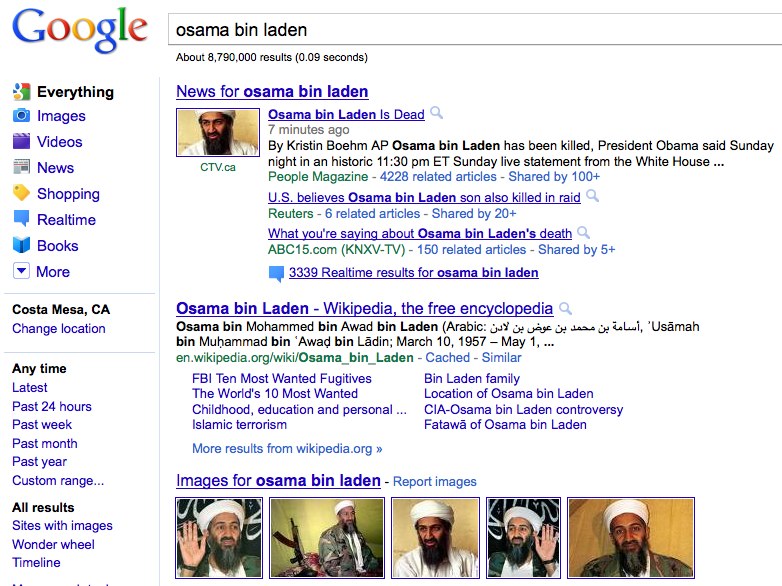
You can see how Google was literally telling people to turn on their televisions. That’s because the results they got, if they did a search, were chilling, sad and not reflective of the tragedy that had just unfolded — one results (I’m still digging it up out of my archives) suggested seeing the view from the top of the World Trade Center.
Google eventually resorted to using its advertising space to tell people to look elsewhere:
The problem was that Google had no news search engine. That’s since changed. Indeed, 9/11 and Google’s poor performance in providing information helped bring about the creation of Google News. And that’s what brings the improvement to Google today, causing its results to be topped by news reports:

I wasn’t online when the news first started circulating about Osama bin Laden being dead around 7:30 PM Pacific Time, so I’m not sure how Google’s results looked then. But I suspect that tweets began filling the gap until the news reports started appearing.

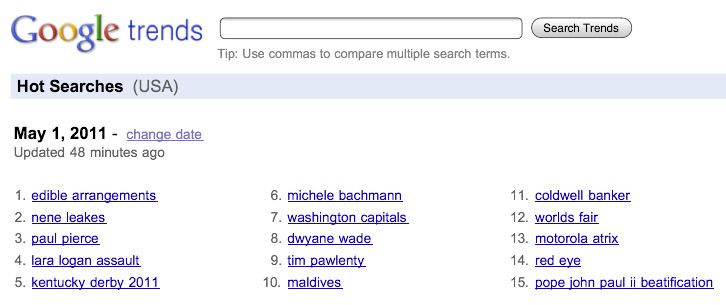
Despite the obvious interest, Google Trends (which reflect “rising” searches that are often propelled by news events), was slow to reflect queries. Here’s how it looked as of 8:54 PM Pacific Time, about 20 minutes after President Obama made his speech about bin Laden’s death:

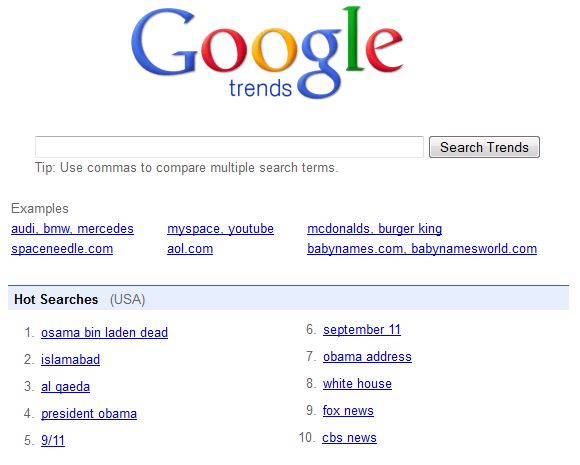
But by 9PM Pacific Time, the results finally changed (they get updated hourly). Here’s the look from 9:06PM Pacific Time:

The top rising search was “osama bin laden dead” followed by “president obama.” With some irony, given Donald Trump’s attacks on Obama’s birth status, “celebrity apprentice 2011″ was ranked third. The show aired this evening.
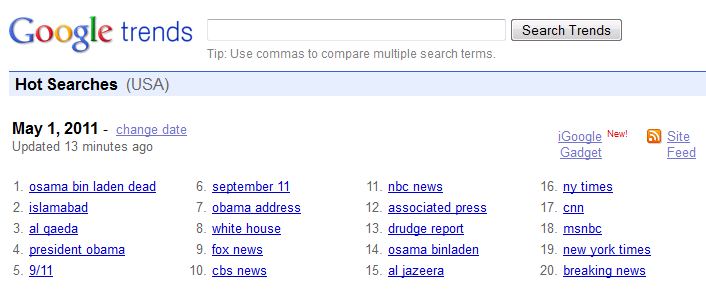
The trends have since been updated again and reflect new interest in the story, as more details have emerged:
“Islamabad” is in the top queries, no doubt as people try to learn more about this closest major city to where bin Laden was killed. There’s interest in “al qaeda” and “9/11″ and “september 11,” all for obvious reasons. Searches for news sites such as “fox news” and “cbs news” have been pushed further down.
Looking at the full range of top “hot” searches, they are ALL related to the news of bin Laden’s death:

Perhaps this has happened before, where all the searches on Google Trends are dominated by one news story. I don’t know for certain. But I do know that it is very, very unusual — a sign of just how much interest there is.
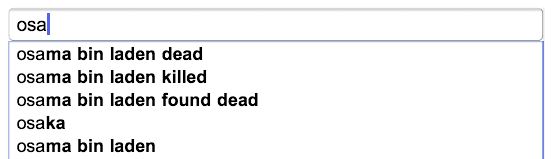
Similar to Google Trends, Google Autocomplete — which is influenced by searches that are rising in popularity — initially didn’t have a suggestion about bin Laden being dead. Here’s how it looked to me at 8:54 PM Pacific Time:


And here’s how it looked at 9:06PM Pacific Time, when the query volume finally got reflected in the suggestions:

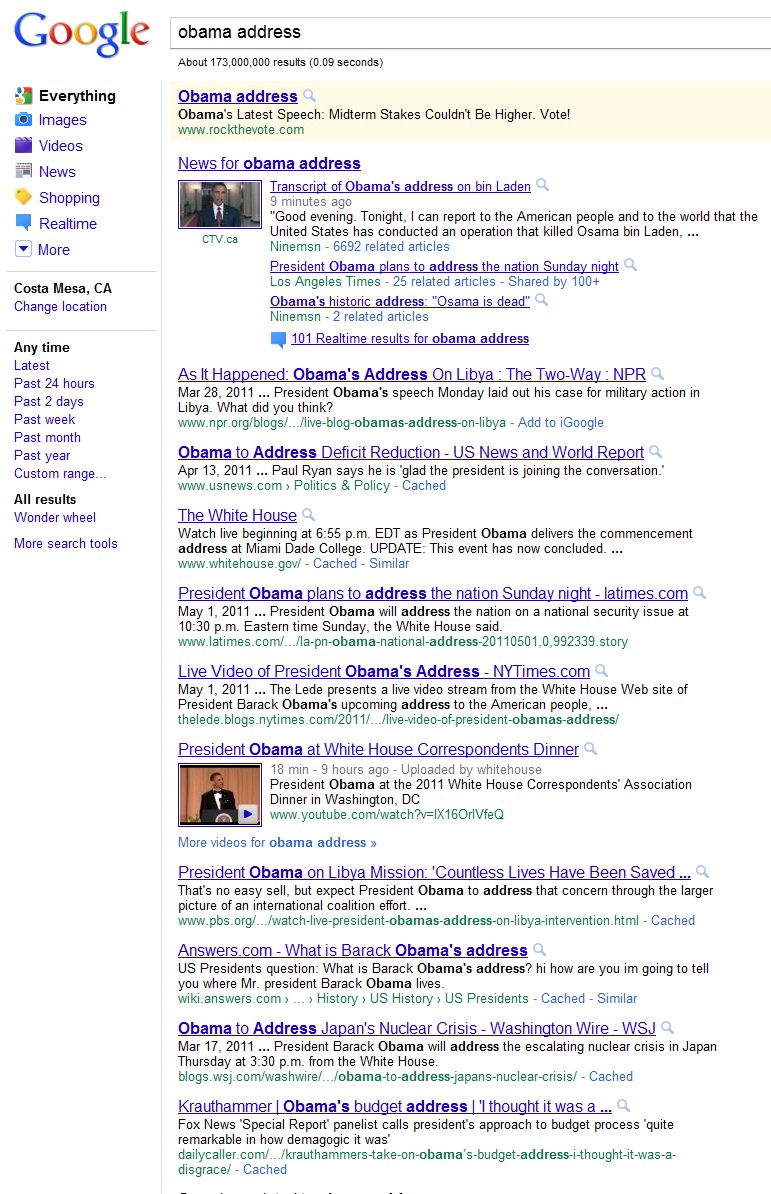
Back to Google Trends, one of the top queries is “obama address.” What do you get for results? News at the top but a pretty mixed bag after that:

After the news results, only three of the results after that are about tonight’s speech — and they don’t really stand out. Other listings cover Libya news, one on the Japanese nuclear crisis, another on the budget and Answers.com shows up talking about where Obama’s actual residential address is.
Well, “obama address” can and does have multiple meanings. You can expect these results will become more specific to tonight’s address, as the results get updated. I was still surprised, however, that 2 hours after Obama’s speech, the results hadn’t changed.
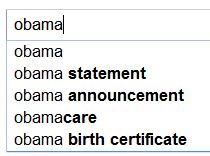
What’s being suggested, by the way, for a search on “obama? Oddly, not “obama address” as in Google Trends but rather “obama statement” and “obama announcement,” as shown on the right.
This might reflect how Google Trends is a bit behind. People might no longer be wanting information about a forthcoming statement but rather the actual statement (you’ll find it here) that was delivered.
I actually searched for “obama speech” myself and got a really strange juxtaposition:
At the top were news results about bin Laden’s death. Below that, links to Obama’s humorous short “President’s Speech” movie this weekend, which seems to have been well received, at the Whie House Correspondents’ Association.
The results have since changed, as they will of course do for any and all searches, over time.

Thursday, April 28, 2011

What to Do When Your Link Building Gets Stuck


Sooner or later it is bound to happen. You or your SEO professional are in month nine of the year-long link building strategy and you’ve hit a wall. It feels like there are no more quality blogs to comment on, your list of directories to submit to is getting smaller and good, new ones increasingly hard to find and creating new content feels like pulling teeth. You’ve hit the link building wall. If you work in a relatively niche industry, you may hit this wall sooner than others. But don’t let this stop your link building efforts or SEO tactics in general.
Here are a few ideas of what to do when your link building gets stuck:

Don’t get frustrated

It’s easy to feel like you are banging your head against a wall. The first thing to remember is to not get frustrated. Frustration leads to desperation which can lead you into black hat SEO territory. No matter how slow the link building is getting, it’s never worth using black hat SEO techniques to keep the process moving.

Take a look back

Sort through your previous link building activities and check on blogs you commented on to see if the comments actually went through. If they didn’t, trying commenting on another post on that blog. It’s possible that the blog owner isn’t actively monitoring comments, but that doesn’t mean you should keep from trying again.

Also look back at your directory submissions and make sure those got posted. If they didn’t, try resubmitting your URL. If the link did go through, make sure you filled out the profile as completely as you could. If you’ve updated any keywords, go in and edit the profile description to match.
Double check on your article submissions. If an article didn’t go through, feel free to resubmit it to a different site. Why let good content go to waste? As long as it is still relevant, you can publish it on another site.

Check out the competition

If you are really stuck, check out what kind of SEO your top three competitors are doing. What blogs are they commenting on, what kind of news are they pushing in press releases. Maybe one of them stumbled upon a really good link building source that you can use for your own efforts. What associations are they apart of? What trade shows are they going to? Their on- and offline marketing efforts might just be the inspiration you need.

Look outside your industry

If you’re a company that makes tennis rackets, you’ve probably focused your link building efforts to the tennis/tennis racket industry. Take a look outside your specific niche and find related industries that you can work with. Why not see if you can make headway elsewhere? Think outside the box and see where that takes you.
The important thing is to not give up. With so much time and effort already invested in your link building strategy, don’t throw away what you’ve done because you aren’t sure where to go.