Showing posts with label advanced seo. Show all posts

Friday, December 2, 2011

Do As I Say, Not As I Do: A Look At Search Engines & SEO Best Practices

Now that the holidays are upon us, we all probably could use some cheering up. So I thought I’d have some fun with our favorite search engines: Google, Yahoo, Bing, YouTube, and Blekko.

At Nine By Blue, I have been developing software that automatically checks sites for technical SEO best practices. Normally we run it on our clients’s sites to quickly check for issues and monitor them for any future problems.

But I was curious to see what I would find if I pointed the software at some typical pages on the search engines’s sites and then compare their implementations with the technical SEO best practices that we typically recommend.

Below is a list of some of the issues that I found in no particular order.

Disclaimer #1: This list is intended to point out how difficult it is to fully optimize a site for SEO, especially large-scale enterprise sites. I’m not claiming that I could have done any better, even if I had full control of these sites.

Disclaimer #2: Yes, I’m aware of Google’s SEO report card, but I have never read it because it is too long. Also, I didn’t want to be influenced by it.

Use a Link Rel=Canonical Tag On The Homepage

Most of the sites that I reviewed had many different URLs that lead to the home page. This can be because of tracking parameters (i.e. http://www.site.com/?ref=affilliate1) or default file names (i.e. http://www.site.com/index.php), or even duplicate subdomains (http://www1.site.com/).

Because of this, I always recommend putting a link rel=canonical tag on the home page. This ensures that links to these different home page URLs all get counted as pointing to the same URL. I also recommend adding this tag for any other pages that might have similar issues.

I was surprised to find that Bing was the only site that had a proper link rel=canonical tag on the home page.
YouTube also has a link rel=canonical tag, but it was pointing to an improper URL “/” instead of the full URL “http://www.youtube.com/”.

Avoid Duplicate Subdomains & 301 Redirect Them To The Main Subdomain

With a few exceptions, I have been able to find a duplicate copy of the sites that I review.

I have a list of typical subdomains — like www1, dev, api, m, etc. — that will generally turn up a copy of the site. Other duplicate copies of a site can be found at the IP address (i.e. http://192.168.1.1/ instead of http://www.site.com/) and by probing DNS for additional hostnames or domains.

These duplicate subdomains or duplicate sites have a negative effect on SEO because they make the search engines crawl multiple copies of your site just to get one copy. It can also cause links intended for a particular page to be spread out among multiple copies, reducing the page’s authority.

The best way to fix this is to use a permanent (301) redirect to canonical subdomain’s version of that URL. If that isn’t possible, then a link rel=canonical tag pointing to the canonical subdomain page will work almost as well.

For example, an entire duplicate copy of Bing.com is available at http://www1.bing.com/. Compounding this is the fact that the page has a link rel=canonical tag also pointing to http://www1.bing.com/ and all the links on the page point to www1 as well.

Other subdomains, such as www2 through www5 and www01, all properly redirect to www.bing.com with a 301.

Blekko has an old, pre-launch copy of its site at http://api.blekko.com/. (Here is their old executive page.) Fortunately, this subdomain has a robots.txt file that is preventing it from being crawled. But these pages, like the old executive page at http://api.blekko.com/mgmt.html is also available at http://dev.blekko.com/mgmt.html and the main subdomain at http://blekko.com/mgmt.html.

It would be better to 301 redirect these URLs to the current management page at http://blekko.com/ws/+/management than to leave multiple copies of them on different subdomains.
YouTube redirects its duplicate subdomains www1 through www5 to www.youtube.com, which is in line with best practices. Unfortunately, it redirects with a 302 (temporary) redirect rather than a recommended 301 (permanent) redirect.

Use Permanent Redirects From https: URLs To http: URLs IF They Don’t Require SSL

Another type of duplicate copy of a site that I usually find is the SSL/https version of the site. https is appropriate for pages that require security, like a login page or a page for editing a user profile, but for pages that don’t require security, it is a source of duplicate content causing crawl inefficiency and link diffusion.
The recommended solution for this is to redirect pages from https to http whenever possible.

Our software detected duplicate https copies of most pages, including Microsoft’s help pages, the YouTube about pages, Google’s corporate page, and even the Google webmaster guidelines.

The duplicate content issue with the Google webmaster guidelines page (and the other Google help pages) is compounded by a link rel=canonical tag that points to either the http or https version of the URL, depending on URL is requested.

It is important to make sure that the link rel=canonical tag always points to the intended canonical version of the page, so be careful when dynamically generating this element.

A request for https://www.bing.com/ results in a security warning (shown below) due to a mismatched SSL certificate. This is common for sites using Akamai for global server load balancing.

It even pops up for https://www.whitehouse.gov/. I’m not aware of a way to get around this issue, though I would love to talk with something at Akamai about this.

Use Robots.txt File To Prevent URLs From Being Crawled

Sites generally have different types of pages that they don’t want to have search engine’s index. This could be because these pages are unlikely to convert or aren’t a good experience for users to land on, like a “create an account” or “leave a comment” page. Or it could be because the page is not intended for Web browsers, like an XML response to an API call.

Bing’s search API calls, which are made to URLs starting with http://api.bing.com/ or http://api.bing.net/ can be crawled by spiders according to the robots.txt file. This can be devastating to crawl efficiency because search engines will continue to crawl these XML results even though they are useless to browsers.

A search on Google for [site:api.bing.net OR site:api.bing.com] currently returns about 260 results, but based on analysis I have done on clients’ Web access log files, it is many times more URLs than these have been crawled and rejected.

Use ALT Attributes In Images

Images should always be given alternate text via the ALT attribute (not TITLE or NAME as I have seen on some sites). This is good for accessibility issues like screen readers, and it provides additional context about a page to search engines.

Though many images on the pages that were checked had appropriate alternate text, I couldn’t help but notice that Duane Forrester’s image on his profile page didn’t. But he is in good company because Larry, Sergey, Eric, and the rest of the Google executive team don’t either.

Avoid Use Of Rel=Nofollow Attributes On Links To “sculpt PageRank”

A rel=nofollow attribute on a link tells search engines not to consider the link as part of its link graph. Occasionally, I will review a site that attempts to use this fact to control the way that PageRank “flows” through a site.

This technique is generally considered to be ineffective and actually counterproductive, and I always recommend against it. (There are still valid uses for rel=nofollow attributes on internal links, such as link to pages that are excluded from being crawled by robots.txt.)

None of the search engine pages I checked were using rel=nofollow attributes in this way with the exception of the YouTube home page.

In the image below, nofollowed links are highlighted in red. Links to the most viewed and top favorited are being shown to search engines but general music, entertainment, and sports videos are not.

Return Response Codes Directly

A URL that doesn’t lead to a valid page should return a 404 (page not found) response code directly.
If an invalid URL is sent to Bing’s community blog site, it will redirect to a 404 page. Here is the chain:

  1. The URL http://www.bing.com/community/b/nopagehere.aspx returns a 302 (temporary) redirect to
  2. the URL http://www.bing.com/community/error-notfound.aspx?aspxerrorpath=/community/b/nopagehere.asp, which returns a 404 (page not found) response.

The recommended best practice would be for the first URL to return a 404 directly. If that isn’t possible, then the redirect should be changed to a 301 (permanent) redirect.

Yahoo’s corporate information pages do something interesting when they get an invalid URL.

A request to http://info.yahoo.com/center/us/yahoo/anypage.html, which is not a valid URL, correctly returns a 404 (page not found) response.

But the 404 page contains an old school meta refresh with a time of one second that redirects to http://info.yahoo.com/center/us/yahoo/.

A 301 redirect to this page is the recommended way to handle these types of invalid URLs.

Support If-Modified-Since/Last-Modified Conditional GETs

I am a big fan of using cache control headers to increase crawl efficiency and decrease page speed. (My article on this topic is here.)

I found it interesting that out of all the URLs that were checked only a few Google URLs supported If-Modified-Since requests and none of the URLs supported If-None-Match.

Periodically Check Your DNS Configuration

As part of a site review, I like to use on-line resources like http://intodns.com/ and http://robtex.com/ to check the DNS configuration.

DNS is an important part of technical SEO because if something breaks with DNS, then the site will go down and it isn’t going to get crawled. Fortunately, this rarely happens.

However, I have reviewed sites that had their crawling affected by DNS changes. And I have reviewed several large sites that had their DNS servers on the same subnet, essentially creating a single point of failure for their entire business.

As expected, all the search engines had no serious DNS issues. I was surprised to see that two of them had recursion enabled on their name servers because in some rare instances that can be a security risk.
My recommended best practice is to run these types of checks at least once a quarter.

Conclusion

These are a few of the issues that were found that I commonly see or think are important. There were others, but they were relatively minor or subtle things like short titles, duplicate/missing meta descriptions, missing headers, and too many static resources per page.

Normally, I would have access to Web access log files and webmaster tools, which allows our software to check a lot more things.

I hope this gives you some ideas for things to check on your own site. And I hope that when you find something that you realize that even the search engines have their own technical SEO issues from time to time.

Source: http://searchengineland.com/do-as-i-say-not-as-i-do-a-look-at-search-engines-seo-best-practices-102698

Tuesday, June 28, 2011

SEO Your Website For Foreign Market Acquisition

Global Currencies
Any U.S. company looking to expand into foreign markets must first ask whether this is the best decision for their business. Laws, payment processing, and taxation are all questions for legal and your accountant, so let's instead focus on the pros and cons of foreign expansion from an SEO and marketing standpoint.


Market Size
For anyone heading into foreign markets, the first consideration is the smaller market available in those areas. U.S. companies looking to market into Canada using SEO, for example, are marketing now to population roughly one-tenth the size.

On the other side of the coin, because of the smaller markets and the generally reduced interest in attaining them, the competition is almost always lower.

The big question is how much work will it be to increase your targeted traffic in the U.S. market against your current competition? If you compare that with the work required to expand into foreign markets and find that the balance is in your favor, then you know what to do. Answering this question can require in-depth keyword and competition analysis.

Keywords
We all search differently. While there are significant differences in how various regions in the U.S. search, the differences are even larger when one bridges through larger cultural gaps such as marketing into the UK or Canada. From spelling differences and even word differences (“truck” in the U.S. vs. “lorry” in the UK) to tendencies – you need to be aware of what you're heading into and what it means.

We're all already aware of spelling differences such as color vs. colour, but when we look at sectors more closely you'll find there are a lot of other differences. In Canada, for example, people are more apt to look for reviews and include words like “review” or “compare” in many of their service and product searches. This tells us what we need to do for keywords and a lot about intent and desire.

When launching an SEO campaign into foreign markets, you need to know what these keyword targets should be and what your site needs to deliver. You may also need to look outside your central keywords.

If you’re a property management company should you be targeting “accommodations” or “lodgings”? That depends on who you're marketing to (and can sometimes even depend on what time of year you're marketing, depending on the place).

Your Website
Is your website all wrong? A red, white, and blue website with a big “Made in America” logo works very well in the U.S. market and so it should. But if you're marketing to the UK, will it really have the same impact? It may not work against you per se, but if it's not helping then its real estate that can be better used.

You also need to understand the people you're marketing to. Read and review the ranking websites in that country and get an understating for the sensibilities they cater to.

What imagery appeals to that market, what spellings, and even what slang is used are all very useful. Make your foreign readers feel comfortable with what you're saying and it's likely they won't even question that you're geographically located away from them. You understand them and their needs – what more can they ask?

One vs. Multiple Sites
So if your site is all wrong what can you do about it? We end up asking whether it's better to optimize one site for multiple locations or host a different site for each geographical location.

To be clear: I'm not one to promote using multiple sites to rank multiple times for the same phrase, but there are advantages to hosting unique websites for each location. Major online giants such as Expedia, eBay, and even Google do just this.

The advantage to maintaining one site is clear – it's a lot easier to manage the content. That's also one of the biggest disadvantages simply because the same content isn't going to work for all audiences. Also, providing different content for different location on the same site (using IP detection for example) may well set you up for a cloaking penalty if not done exactly right.
Hosting multiple sites for different location gives you the opportunity to cater the content to that specific audience and make adjustments to the site based on the statistics pulled from just that segment.

If you hosted “yoursite.ca” to cater to the Canadian market and noticed visitors were bouncing away you'd know who they were and be able to analyze the site to determine why fairly easily. Furthermore, you wouldn't be limited in how you react to that data – worrying always about losing your US visitors in any changes.

A hosted site for each market also allows you to follow the semantics and spelling differences. You may want to have your copy written by someone in that country just to be sure you're truly covering the voice of that population.

Having multiple sites will further give you the opportunity to host your site in the country you wish to rank in and using the country-specific URL for that region. This will give you the double benefit of building trust with your targeted visitors and help in your SEO efforts.

There is some disagreement among SEOs on the value of country-based domains and on hosting location. I personally feel they do hold weight as factors and have seen cases to support this numerous times. If it doesn't matter then it's a zero-sum scenario; and if it does, you'll come out ahead. So why not?

Just to be very clear: I'm not supporting the use of multiple sites to rank multiple times for the same phrase on any one engine. This practice doesn't help the searcher and could cause you to suffer penalties, which won't help you in any way.

In-depth competitive analysis on ranking sites domestically vs. into foreign markets clearly illustrates the advantages of acquiring links from foreign website to point to your site. This seems to be the case whether you're trying to rank in foreign markets or not. We've seen:

  • .com U.S. site rank highly in foreign markets with solid links from that geographical location.
  • co.uk sites fare poorly in the UK market with the majority of their links being from U.S.-based websites.
  • .co.uk sites faring better against .com domains even if the .com has more links from the UK.

When you're looking at your link building strategy, you’re going to need to focus it on links from that region. This isn't to say that you should refuse a solid link from outside the area, but when you're focusing your specific energies – they need to be focused where they'll get the most effect and that's from the region you're trying to rank well in.

Bottom Line
You're going to have to ask yourself, “Is it worth it?” Ranking one or multiple sites across multiple regions (or at least ranking well across them all) can be a large task, but the efforts can often prove highly fruitful as most foreign markets are less competitive than their U.S. counterparts. While it'll take time and effort, it may well take less time and effort than the amount of work required for the same overall traffic and ROI increases by focusing entirely on the U.S.

Diversity is security. The broader your marketing and client-base, the more secure you are from economic, currency, and even algorithm shifts.

Sunday, June 12, 2011

SEO for Small Businesses: Get Into Action

to-do-pile
Web marketing can seem overwhelming sometimes, even for professionals, let alone for small business owners just starting out with promoting a new site. There are so many areas and there is so much to learn – and the goal posts are always moving. Google is constantly developing their algorithm, and there seems to be something new in the world of social media every day.


However, the single most important thing when it comes to marketing your small business, whether online or offline, is simply getting into action. No amount of expert knowledge will help you if you're not using it, and even a little knowledge will get you a long way if you're out there putting it into practice.

Learning everything you can before you start is great if you can do it, but all too often it turns into a mental block. We get overwhelmed and end up doing nothing. 

Anyone who has worked with a personal coach in any area of business or life will have heard this mantra over and over again: get into action with what you can manage now (however small), build your confidence and knowledge over time, and work toward larger tasks; don't get bogged down by being too ambitious or by trying to do everything at once. Long to-do lists are the enemy!

Applying Habit Forming to SEO and Web Marketing

The biggest problem you will face as a small businessperson is that most tasks associated with SEO fall into the category of important but not urgent (as are most tasks associated with working on, rather than in the business). We get caught up with all the super-urgent day-to-day stuff (deadlines to meet, bills to pay), so the long-term development of our business suffers.

Now, if you're incredibly disciplined or have a boss breathing down your neck, this doesn't pose so much of a problem. But if you're like most of us mere mortals or are working for yourself (or if you are the boss!), then we need to do some work. The answer is to develop a system or structure, combined with small, short-term targets, to get you into the habit of regular action.

I use the word "habit" very deliberately here. It too often goes along with "bad," but habits don't have to be negative things at all. 

We all have plenty of habits, both good and bad, that together make up our daily routine. What we're talking about here is making those non-urgent but very important SEO tasks a part of that daily routine.

Using a system is important, as it ensures regular action and the measurement of that action (and associated results), regardless of your level of mood, energy or inspiration (let's not kid ourselves: if you're working by yourself, these can be huge factors, even if they're not meant to be). It's easy to get into action around something if you're feeling inspired or bursting with energy, but what about when that initial enthusiasm runs out? The tasks still need to be done. 

Just as with exercise or dieting, so many people start out with the best of intentions and ambitious goals, but peter out quickly. However, the benefit only comes with the long term.

How you will put this system together is up to you. It depends on where you place your focus (link building, content generation, social media?) and what works for you personally. However, any successful habit-forming system will have the following components:

  • Frequent action: At least once per week, if not more often.
  • Regular action: Those actions need to be done at the same time of day or the same day of the week every time. Your brain doesn't fix the habit otherwise.
  • Records: Make a note whenever you complete one of your regular actions, so you can go back and review your progress.
  • Short-term targets: Manageable targets that you can see yourself progressing towards with every step.
  • A stick and a carrot: These are more personal, but most people work best when there are both rewards and punishments in the offing. One or other by itself isn't as effective. Set them yourself but get someone else to enforce them for you if you don't have the discipline!

Setting Targets

We're trained from a young age to set big, ambitious and long term targets... and always bigger and always more ambitious! These are fine in the right context, but are often misused. They can be very disconnected from everyday actions and become fictional very quickly, as soon as your original enthusiasm has died out. This is a great way to get conditioned to failure rather than success... so we set another big, ambitious goal and the cycle repeats.

This is a especially true when it comes to SEO: the payoff can come a long way in the future, and it can be disheartening to work away at building great content and links for no immediate return. This is why you need small, short-term goals to work toward. They make it clear to yourself that you are making progress.

Again, these goals will depend on you and what you're doing. However, they must always be challenging but something that you fundamentally know that you can do – not a pipe dream. They must also be something that you control fairly directly (rather than relying on external forces).

So, if you're starting a new blog, instead of setting "A-list celebrity blogger within a year" as your goal, try setting "250 visitors in my first month" (or whatever seems realistic to you, depending on your niche). The target for your next month might be more ambitious, based on how you did in your first, or you may decide to concentrate on something else ("be mentioned 25 times by other bloggers in my niche this month").

By all means, keep your big goal in mind – but focus on the small steps. You'll be much more likely to get where you want to be.

Summary

By far the most important thing is just getting into action. Don't worry about what you don't know, or what other people say you should be doing – just do what you know you can do and build from there. Create a system that will let you form habits around doing those important, but not urgent, tasks.

Thursday, June 9, 2011

Introducing: The Periodic Table Of SEO Ranking Factors

SEO — search engine optimization — is one of the most important marketing activities available to companies and publishers, but it’s too often considered some murky “dark art” or a sinful practice that should be avoided. It’s not. To help clear away some of the mystery and fear for those new to SEO, and provide a “reset” for those who are experienced, we’ve created “The Periodic Table Of SEO Ranking Factors.”


Clicking on the image above will take you to a download page with big PDF versions and sharable images of the whole chart, with short explanations. However, we’ve permanently housed it here, where it leads into a detailed guide that explains more about what the chart encompasses. This introduction to the table is meant to explain more about the “why have one” rather than the “what does it mean.”


SEO: It’s A Good Thing!


As a reminder, SEO is not a crime, a harmful act nor something that only “bad” people do, despite what you may have seen on The Good Wife. It is, in fact, a helpful activity that even the search engines, including Google, recommend.

If you want to understand more about some of the myths of SEO being “bad,” I’d recommend the further reading below. Seriously, take some time to educate yourself:


SEO’s Fundamental Factors


SEO can be confusing to both new people and experienced folks alike. For new people, it can seem like rocket science, because you might get overwhelmed with all the details and miss the relatively easy general principles. For experienced people, chasing down which particular hot new SEO “tree” to climb can blind you to the overall forest that you should be considering.

The Periodic Table Of SEO is designed to visually present the major factors, the biggest and most important things that can help you in gaining traffic from search engines. It’s focused on traffic from web search results, though down the line, we might produce similar ones for more focused search engines such as video or local. By the way, the Local Search Ranking Factors survey from David Mihm has just been updated.


There are the “On The Page” factors, the things that a publisher can control directly. “Off The Page” factors, which are things you can influence indirectly about how others can help, or harm, your chances of search engine visibility. “Violations” are the things you should avoid, sometimes common mistakes that developers or others might not even realize shouldn’t be done. And “Blocked” covers a new class of not-violations but still things that can be harmful.

Focus On Most Important Factors


Within each of these major groups are individual factors. There could be many more individual factors than we show. However, we’ve made a deliberate decision to show only those we think are most important, most consistently seen used by search engines, or verified by SEO data or commonly accepted and easily implementable.

For example, in HTML factors, we recommend paying attention to:
  • Title Tags
  • Description Tags
  • Header Tags

We don’t try to get into whether a word you hope to be found for comes first or last in the HTML title tag. Or whether an H1 header tag carries more weight than an H2 header tag. We don’t suggest that you need to use bold text.

We avoid all that, because we feel it goes too much into unnecessary and possibly confusing depth for many people. Instead, if you know that your pages should have good, unique titles, that they should have structure that can be reflected by header tags, and that you should use the easily implemented description tag, you’ve probably covered 90% of the most important HTML-related factors.

In addition, some of the factors we list are more general goals to reach rather than specific factors that can be implemented. For example, our social factors include attaining a good social reputations and good social shares. A good social reputation on Facebook? Or Twitter? And social shares on both, or only one — and what about Google +1?

All of the above. Rather than getting lost on if Facebook or Twitter is better, or has more SEO juice, we want you to understand that social activity is increasingly having an influence on search rankings. So you want a good social reputation in a variety of networks. You want to be shared on a variety of networks. Those are among the most important general social goals you can go after.

An Overview Teaching Guide


If you want a deep-dive into those types of specifics, SEOmoz does a biannual survey of search engine ranking factors you should certainly read (it’s due to be updated very shortly). Our ranking factors table isn’t a replacement for that or others. Instead, we view it as a complementary guide.

In particular, I personally hope that it’s the type of thing that anyone versed in SEO can use to help someone else get up to speed on the fundamental building blocks. Have you done Cr, research into keywords? Here are some tools to help. Or that As — site speed — is important factor.

The factors are weighted on a scale of one to three, with three being deemed more important, though anything listed is deemed a fundamental. Not everyone may agree with how we’ve scaled things, but it’s a start. And everything’s relative. No single factor guarantees success, but having several of them increases the odds.

Blast From The Past


From a nostalgia perspective, I started writing about SEO over 15 years ago, with my first article going up in April 1996. It had an SEO ranking factor chart as part of it, which looked like this:


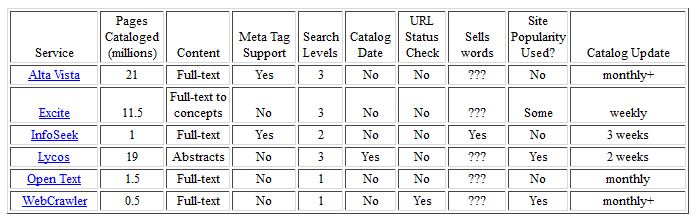
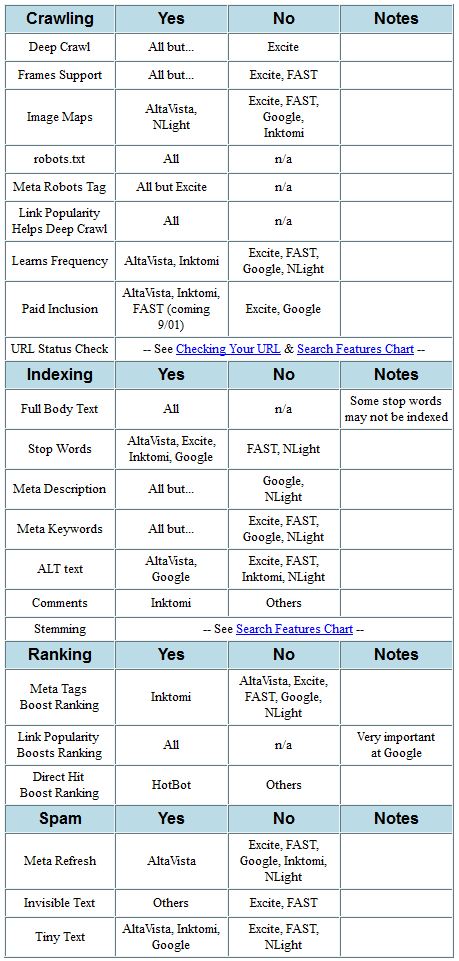
This grew rapidly by the following year, to cover issues such as whether frames posed a barrier to being crawled. Here’s only part of the successor to my original chart, from November 1997:


Here’s a version from July 2001, which makes me smile as I remember that for a short period of time, how a site performed in Direct Hit’s clickthrough measurements could have a ranking impact:


I stopped maintaining this type of chart in 2003. In part, it was because a lot of the major “signals” or factors used by the different search engines were becoming more and more the same. The world also became fixated just on Google, which in term was largely driven by rewarding those with the best links.

I found it nice to come back years later and think afresh about how I’d organize the factors. It was fun to put back on my graphics reporter hat, which I haven’t worn since I used to do infographics work in my pre-search engine life.

Of course, I’m not an artist. Turning the periodic table into a great visual concept was the work of the good folks over at Column Five Media, which has a wonderful portfolio of infographics. It was a pleasure to work with them. Special thanks to Jason Lankow and Josh Ritchie.

Also thanks to our technical director Michelle Robbins, who did a ton of last minute work to get the chart ready to go online here.

If you enjoy the chart, find it useful — please, reward our Cq with some Ln, Lt and especially Lq. Also appreciated is any Ss. Give us some Ce, too. Comments are more than welcome. And the best with your SEO!

Friday, May 20, 2011

Link Building For Life: Determining Lifetime Link Value

The ideal goal for some SEOs is to minimize maintenance and effort for a given website. Get to number one for all desirable keywords, sit back, and then move on to the next website while the previous domain rakes in the cash. This dream scenario is unfortunately rarely the case, because there are other competitors that make number one an increasing difficult mark to hit – and, also, most notably – the link graph has a rapid rate of attrition.

Losing Value – Losing Links

Every website succumbs to the reductionist nature of the web. Although the number of pages increase, the link graph also has a way of deteriorating – meaning that many of the initial links you receive could end up declining in value or otherwise, outright disappearing.

Your backlink profile, if ignored, will shrink considerably, and that number one ranking – or any ranking at all – could be lost. If that ranking’s future value is taken care of like a child and nurtured into adulthood, it’s even possible you can let it off into the real world – without needing but a phone call or two to maintain the same connection.

What you need to do to maintain your link graph – and/or insure its links appreciate in value – is be rigorous in the evaluation of the domain you’re attempting to get a link from. There is much, much more to the value of a link than the present value of the page. SEO is a long term game, so it only makes sense to future-proof your links.

Doing so can make one link, of seeming equal value to another link now, worth 2x as much in terms of lifetime link value (LLV).

Like the much referenced business methodology customer lifetime value (CLV), lifetime link value is a process – and an ideology – that can separate a highly profitable SEO campaign from one that barely covers your bills for McDonalds.

Determining Lifetime Link Value

Although I don’t suggest you plug approximate values in an equation to determine the LLV of any given link, keeping it in mind as a strong delimiter in determining link value is something every SEO should do.
A link with the a high lifetime link value has the following characteristics:
  • It will exist on the page as long as the page exists. That is, it is not a “rented” link or a link that faces temporary restrictions, like a listing as a speaker on the frontpage of a major conference website, or as a sponsor of an upcoming, yearly event.
  • Its positioning/stance in the current site architecture makes it unlikely it will ever “fall off” the link graph. Many websites, namely blogs, have a temporal state that poorly aligns with site architecture, meaning that your link will eventually be more than 10 clicks from the homepage. When this happens, and no other external links have been obtained, it is a near certainty that it will eventually be worth but a sliver of value, or completely fall off the link graph.
  • It exists on a domain with an upward backlink growth trend. If a webmaster is still actively promoting his or her website, it is a near certainty that link growth continues to trend upward. On the opposite side, if a website is trending downward, it is probable that the webmaster cares less, the topic isn’t as important, and overall, future link value will decline.
  • It is not off topic on the domain in question. Manipulative, off-topic links trigger disdain in the users that observe them. Even if historical trends show an upward climb, if your link is off topic and prominent, now, that’s a good sign that the future value of the link will trend downward.

Breaking Down Link Characteristics

Many SEOs don’t apply their own on-page evaluations to off-site link evaluation. This happens because we get lazy, because links are hard to get, and because we rarely put in deep consideration for domains that aren’t our own.

This lack of deep consideration – or even, deeper than standard consideration – can handicap some teams into getting links that aren’t worth much, that won’t continue to move the needle, and will cause long term costs to be much higher than they have to be.

Temporal Link Factors

How do you know if a link will be removed by a webmaster or other omnipotent party? If you acquired the link manipulatively, there’s a pretty good chance they are likely to do that at whim – especially if you use the popular “link renting” practice that will obliterate LLV. If you sponsor an event that’s yearly or have a link placed on content that doesn’t have perpetual value, you may face the same fate.

Perpetual value is the same concept that pervades with “evergreen content”. Evergreen content won’t succumb to temporal factors that will make the webmaster update them and potentially remove your link. A static page on the best plugins for Chrome is way more likely to have a receding LLV as opposed to a link on a page about “How to Tie Your Shoes” – as I think we’ll be tying them the same way for a long time to come, and those Chrome plugins, and Chrome in general, are way more likely to become extinct.

Site Architecture Of The Hosted Link

Many blogs are poorly constructed. They have posts that fall off the link graph and then just as quickly fall off our lives. They do a bad job of internal linking, there are no pages that serve as homepage-hosted HTML sitemaps – and as such, the best link in the world from the strongest domain can just as quickly become one that disappears if no external domains link to it.

So, in blogs, look for those same things you profess with your own blog. First, archiving and/or tags in the sidebar. The best blogs in the world probably won’t have these, but everyone else (the links you’re probably getting most of the time), should.


Many “big” blogs, such as TechCrunch or The New York Times, can’t possibly do this due to the less-than-amazing look this setup provides, the sheer volume of content they create, and also, because maximizing ad-space is a must. They make up for it through strong internal linking practices in their individual posts. But for those casual bloggers and other micro-sites with less-than-adept webmasters, you’re likely spending a lot of time getting a link from a blog with a terrible LLV.

Similarly, increasingly popular Tumblr is horrendous for SEO purposes, because there is no way to archive anything, and internal linking is terrible. It can offer some real traffic which can turn into other links, but for the pure power of a link, you’re better off twiddling around Blogger.

As it comes to getting posts on blogs (or any site), you should strive for a link that will always be two clicks from the homepage. Any more and you run the risk of losing the power of the link if the domain drops in value, your post is pushed back, or nobody else links to the post.

Historical Backlink Growth Trends

If we’re trying to determine where a potential linking domain is going and has gone, there’s no better option than Majestic SEO’s Backlink History tool.

There are several options to select with this tool to help determine the velocity of link growth for your domain. It’s not perfect, but with a keen eye, it points out clear situations where a domain has hit a wall or is declining, as opposed to a domain that’s growing exponentially.


If we look at Empire Promos and Amsterdam Printing*, two competitors in the promotional items space, we can see an example of this in action. Although both domains have positive growth trends going forward and aggregate domain strength, they aren’t equal domains in terms of probable LLV. The current map shows that it’s likely that Amsterdam will outgain Empire in the future – even if the current value, at least as this graph is concerned, is comparable for both.

Off Topic Link Placement

Manipulative, off-topic links are a sure sign of a domain that will begin to recede in the future. Even if the webmaster isn’t aware of it, the presence of these will mark the future steep decline of the domain – because they greatly impair user experience.

Understand that they will very frequently mark the beginning of the end for the website you’re placing them on. Your time would be better off obtaining on-topic links on evergreen pages – with the site architecture and backlink growth trends that offer a Lifetime Link Value that would make any economist drool.

Source: http://searchengineland.com/link-building-for-life-determining-lifetime-link-value-77030

Thursday, May 19, 2011

SEO & Website Redesign: Relaunching Without Losing Sleep

Redesigns can make an ugly site pretty, but they can also make a high traffic site invisible. Keep these tips and no-nos in mind and you can keep yourself out of the CEO’s office.

SEO Redesign: Teamwork First


It should go without saying, but SEOs, developers and designers must work together cohesively during the site redesign process.

Too often, companies look to refresh the look of their site, and in the end, destroy their search engine presence. How? This can come from a myriad of reasons from coding errors, SEO unfriendly design practices, to even more disastrous practices (e.g., content duplication, URL rewriting without redirection, information architecture changes away from search engine friendly techniques).

Starting the redesign process with a collaborative call between the SEO team, designer, developer, and company decision maker(s) is always the best first step.

Often there are two attitudes present. Either, “We are redesigning our site and are not open to your ideas…but don’t let us do anything wrong,” or the other attitude (and my favorite), “Let’s work together to achieve a refreshed look and functionality and instill any missing SEO opportunities if possible.”

To satisfy both scenarios, your information delivery as the SEO should be to inform designers and developers of the mistakes you shouldn’t make and also to announce to all parties what SEO revisions should be made to the site along with what search engines have recently been paying attention to.

Page Load Time

A site redesign gives you the opportunity to re-code, condense externally referenced files, and achieve faster load times.

Don’t let the designer use the word “Flash” during your call(s). In an attempt to make a new site look pretty, the reliance on multimedia usage can have a negative effect on site speed. Ignoring this is bad, as Google has stated in the last year that site speed is a ranking consideration – also, slower sites annoy users.

Content Duplication


Ensure that your development environment or beta sections of the site are excluded from search engine’s view. Relaunching your site when these elements have been indexed by the engines means your cool new site is a duplicate and you will be in a mad dash trying to redirect the development environment that was leaked. Also, make sure there are no live copies on other servers that have visibility with the search engines.

Another form of content duplication is the creation of new URLs without properly redirecting old URLs via a 301 permanent redirect. This will leave search engines wondering which page should be ranked.

It's also worth mentioning that 301s are a must and that 302 temporary redirects should not be used. Make it commonplace in the redesign process that no one used the word delete in reference to site content. You should never delete any pages, these should be permanently redirected to the most relevant launching page.

Content Restrictions

It’s important before you throw the site to the web that you make sure that you have identified what pages shouldn't be crawled.

Are there new parts of the site that shouldn’t be seen by search engines, login pages, etc.? Does the new site utilize dynamic URL creation or parameters that will need to be restricted?

Inversely, what pages might be restricted that shouldn’t be? Is there a folder in the robots.txt file that is inaccurately excluding pages that should be visible? Have meta robots tags been placed on pages that shouldn’t have been tags?

Tracking


Make sure that your analytical tracking code is placed back in the page source before the site goes live. Additionally, any conversion pages should have the appropriate conversion tracking code appended. Nothing makes an SEO want to cry like lost data.

Information Architecture


A redesign is the perfect time to rethink the direction of the site. Go beyond the need for a refreshed look and analyze the hierarchy of your content. Google is looking at this so be sure there is a clear view of the overall site theme as well as sub-themes flowing into the site through an appropriate folder structure.

URL Rewrite


If you're redesigning and shaking a site down to its core, there's no better time than now. You have the attention and devotion of the site developer to make your URLs right.

This is a continuation of the Information Architecture revisions. Be mindful of folder structure as well as relevant, keyword-rich text usage in page names.

Want to go the extra mile? Have the filename extensions removed so down the road if you redesign the site again and use a different script language you won’t have to do another URL rewrite.

Lastly, make sure all rewritten URLs include a 301 permanent redirect from the old URL to the new URL.

W3C/Section 508/Code Validation


Take advantage of this period to address code issues and how your site adheres to W3C and Section 508 compliance factors. Search engines want to see your excellence here and now is your chance to make their visit successful as well as your human site visitors.

Usability


Can you make the intended funnel of visit shorter or easier? This is great time for you think about what you want visitors to do. You may be able to remove a step in the purchase/goal funnel and increase your site’s convertibility.

Benchmarking


To truly assess the success of the redesign from an SEO and sales standpoint, ensure that you have recorded several site statistics as well as focused monitoring in post-launch. You will be happy you did because it will either be a visible success story or a lifesaver for finding problems once the site launches.
These include:
  • Run a ranking report.
  • Check your pages indexed in Google and Bing.
  • Run a page load time test.
  • Perform a W3C code validation report.
  • Note the bounce rate, time on site, pages per visits, and goal completions. Granted, this can be reviewed in analytics after launch, but be mindful that you should be watching this.
  • Run a site spider crawl of the live site to get a good list of URLs on the current site. You may need this for any clean of missed redirects.
  • Note the average time for Google to download a page and average pages crawled per visit in Google Webmaster tools. Also, “fetch as Googlebot” so you have a previous copy of what Google used to see.
Conclusion


Taking into account all of the mistakes you or the others on the redesign team shouldn’t be making will ultimately leave you much less stressed after the site launches. Meanwhile, minding all the opportunities that a redesign presents from an SEO and usability standpoint can lead to a successful launch and a fruitful post-launch environment.

Now get out there and show them how it’s done!

Source: http://searchenginewatch.com/article/2070968/SEO-Website-Redesign-Relaunching-Without-Losing-Sleep