Showing posts with label panda update. Show all posts

Saturday, February 25, 2012

Infographic: The Google Panda Update, One Year Later

One year ago, Google launched its “Panda Update” designed to filter low quality or “thin” content from its top search results.

Below, our infographic produced in conjunction with BlueGlass covers how Panda works, what it impacted and the various updates from Panda 1.0 through Panda 3.2 that have happened along the way.

After the infographic, you’ll also find more information about the Panda Update ranging from in-depth analysis of how it works, “winners and losers” and well as recovery tips.


Source: http://searchengineland.com/google-panda-update-112805

Tuesday, October 18, 2011

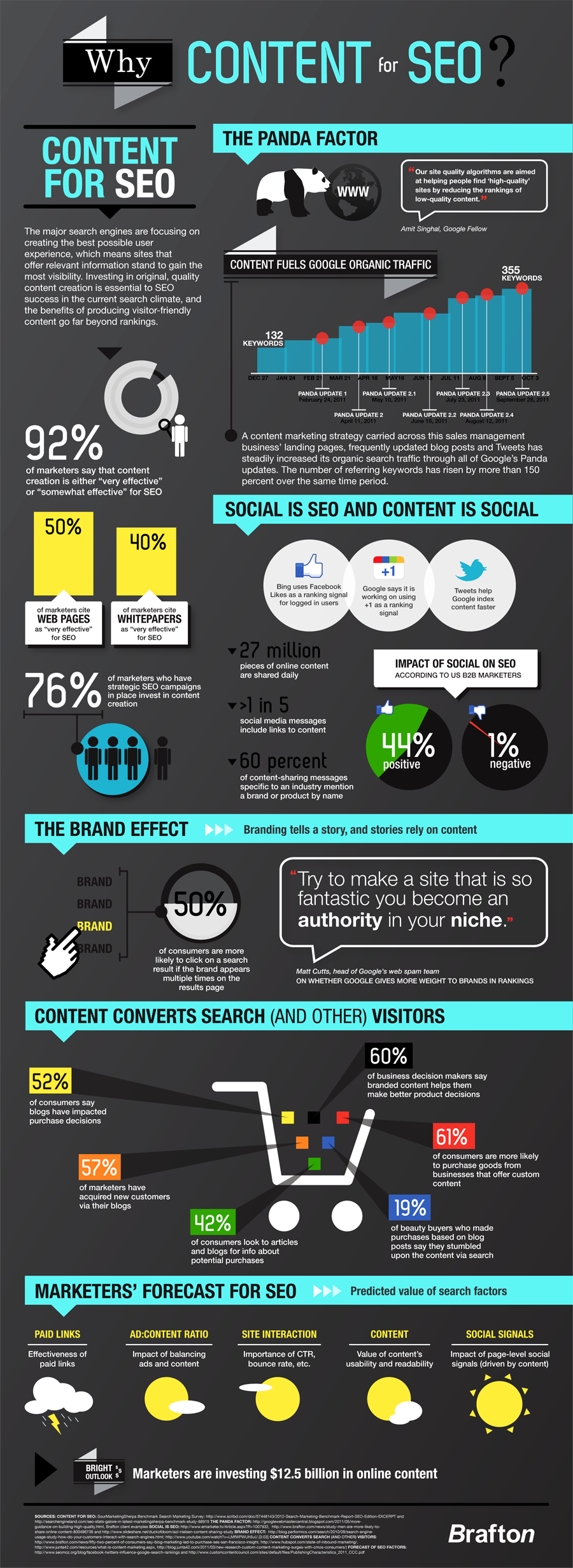
Infographic: Why Content For SEO?

How does content help with SEO efforts? The folks at Brafton have produced a “Why Content For SEO” infographic with lots of stats and information about the topic that you might find interesting:


Source: http://searchengineland.com/infographic-why-content-for-seo-96834

Friday, June 10, 2011

Coming Soon: Google Panda Update 2.2

panda-and-babyOne of the bigger pieces of news — certainly for webmasters and SEOs — from our SMX Advanced conference this week is that Google will soon be releasing version 2.2 of the Panda algorithm update.

Google’s Matt Cutts confirmed that during Tuesday’s keynote question-and-answer session with Danny Sullivan. Cutts said that the update has been approved, hasn’t been rolled out yet, but that should happen soon.

What does Panda 2.2 address?

The next update will target a common webmaster complaint related to the original Panda/Farmer update: sites that scrape and re-publish content and are out-ranking the original source of the content.

“A change has been approved that should help with that issue,” Cutts said.

He also reiterated some previous Panda-related information:
  • Google will continue to tweak and update the Panda algorithm.
  • There have been no manual exceptions made to sites that were wrongly affected, but there have been recompilations of data that may have helped some sites.
  • There’s no exact date yet for when Panda will launch fully beyond English-language searches.

Monday, March 28, 2011

Google Panda Coming to a Market Near You

If you live outside the United States and were unscathed by the Panda Update, a world of hurt may await soon. Or you may be in for a pleasant surprise. It is hard to say where the chips may lay for you without looking.

Some people just had their businesses destroyed, whereas the Online Publisher Association sees a $1 billion windfall to the winning publishers.


Due to Google having multiple algorithms running right now, you can get a peak at the types of sites that were hit, and if your site is in English you can see if it would have got hit by comparing your Google.com rankings in the United States versus in foreign markets by using the Google AdWords ad preview tool.

In most foreign markets Google is not likely to be as aggressive with this type of algorithm as they are in the United States (because foreign ad markets are less liquid and there is less of a critical mass of content in some foreign markets), but I would be willing to bet that Google will be pretty aggressive with it in the UK when it rolls out.

The keywords where you will see the most significant ranking changes will be those where there is a lot of competition, as keywords with less competition generally do not have as many sites to replace them when they are whacked (since there were less people competing for the keyword). Another way to get a glimpse of the aggregate data is to look at your Google Analytics search traffic from the US and see how it has changed relative to seasonal norms. Here is a look out below example, highlighting how Google traffic dropped. ;)


What is worse, is that on most sites impacted revenue declined faster than traffic because search traffic monetizes so well & the US ad market is so much deeper than most foreign markets. Thus a site that had 50% profit margins might have just went to break even or losing money after this update. :D


When Google updates the US content farmer algorithm again (likely soon, since it has already been over a month since the update happened) it will likely roll out around other large global markets, because Google does not like running (and maintaining) 2 sets of ranking algorithms for an extended period of time, as it is more cost intensive and it helps people reverse engineer the algorithm.

Some sites that get hit may be able to quickly bounce back *if* they own a well-read tech blog and have an appropriate in with Google engineers, however most will not unless they drastically change their strategy. Almost nobody has recovered and it has been over a month since the algorithm went live. So your best bet is to plan ahead. When the tide goes out you don't want to be swimming naked. :)

Friday, March 18, 2011

Global Strategies For Google's Panda Update

If all your global sites have low quality links, duplicate content, and are on a subdirectory, then Google's Panda update will likely cause you problems. But don't give up and throw in the towel. You can still get your act together.

This article will give you some insight on some things you can do to mitigate any risk you might be facing and provide some ideas on how to improve your global pages now that up to 20 percent of your competitors may have disappeared.

Assessing Your Pain

Any global search engine optimization (SEO) doctor will first ask you where you feel the most pain. Identifying rank/traffic loss per country is a key strategy. Your site may have lost ranking because of something other than what you initially thought.

Panda's significance is how it views content and links, specifically similar or duplicate content and poor quality links. A thorough assessment of each one of your global sites will give you some insight into where to start and what to start with.

Reviving Your Content

If you've lost positioning with pages that share the same language but didn't lose positioning from your pages that have their own languages, then chances are you got bit by the Panda due to duplicate content.

Remember, duplicate content isn't only because of your English pages. It could also be a conflict between other languages, such as Brazilian Portuguese vs. Portugal's Portuguese or even between Austrian German and German spoken in Germany.

Deduplication will be necessary. Have a content transcriber in your target country re-write the content in your source country. It's time consuming, but well worth it.

Mapping the same keyword to the content is fine, however you might want to de-duplicate your URLs, reduce the amount of AdSense ads you have placed within the content (if any), and while you're at it, make sure to visit Google Webmaster Tools. Google's tools now do a pretty good job geotargeting your URL structures, so if you have a UK subdirectory, telling Google where it's at will help its spiders understand that the UK site is a local standalone site and not part of a content scheme.

Resuscitating Your Link Building Strategy

On the other hand, if you lost positioning and traffic from all of your global sites, it could be due to your link building tactics, especially if you use a subdirectory structure instead of ccTLDs.

A subdirectory structure (e.g., www.example.com/FR/) can face a number of different issues. If you had a link farm in just one country for example, and that link farm pointed to one of your pages, it's likely your whole site would be affected. If you have low quality links pointing to your duplicate UK pages, your U.S. site may suffer.

A ccTLD structure, if you can do it, would help you out a lot at this point. A URL structure like www.example.fr improves trust and engagement with your target audience, and also helps legitimate local link builders point directly to the "correct" site rather than a folder. If you have a subdirectory, make sure to tell Google about it through Webmaster Tools.

The key to it all is planning on making each site useful, relevant and as local as possible to your target market. The days of creating useless duplicated content and participating in link farms are now over.

Source: http://searchenginewatch.com/3642047